Saturday, March 28, 2020

Too Big To See

I made a startling discovery today. As my eyes get dimmer and my hand less steady, I may need to give up painting 40's and go back to 20mm!

Seriously, I kept finding bits I'd missed and eventually realized that with my fuzzy eyes and strong prescription painting glasses, I couldn't keep a whole boot in focus at once. There's also the little problem of increasingly wavering hand when painting lace etc.. So I grabbed a little guy out of the cupboard and I can see all of him at once and  would no longer dream of doing too much fiddly stuff on a little guy since it disappears at arms length now. However, doing 54mm Toy Soldiers still seems to work and be easy so we'll see.
The first half of the Greys, still minus carbines
Anyway, the first half of the Greys are done and have their first coat of varnish if not their carbines (need to cast 2 more). I also realized today, that one of these privates was cast in the officer mould and his ammo pouch is actually a bit of flash, or maybe sprue, that happened to be in the right spot. Yup, good thing I have naturally rosy cheeks. However, I have persevered, what I kept missing up close with glasses on, I won't see at arms length without them! (The horse actually gave him away - hey! That horse moved its leg!!)

Hopefully tomorrow will see the unit finished and I get back to nice simple skirmishers in stripy trousers.

Monday, March 23, 2020

Square Tiling Of A Sphere, Part 3/3

In the previous post I described how I learned about the cube/sphere geometry so that I could put a square grid on a sphere. I ended up spending too much time on that, because it turns out the mapping from cube to sphere wasn't as useful as I had thought. This happens to me sometimes, where I find something fascinating, spend a lot of time on it, and it turns out to be not that important.

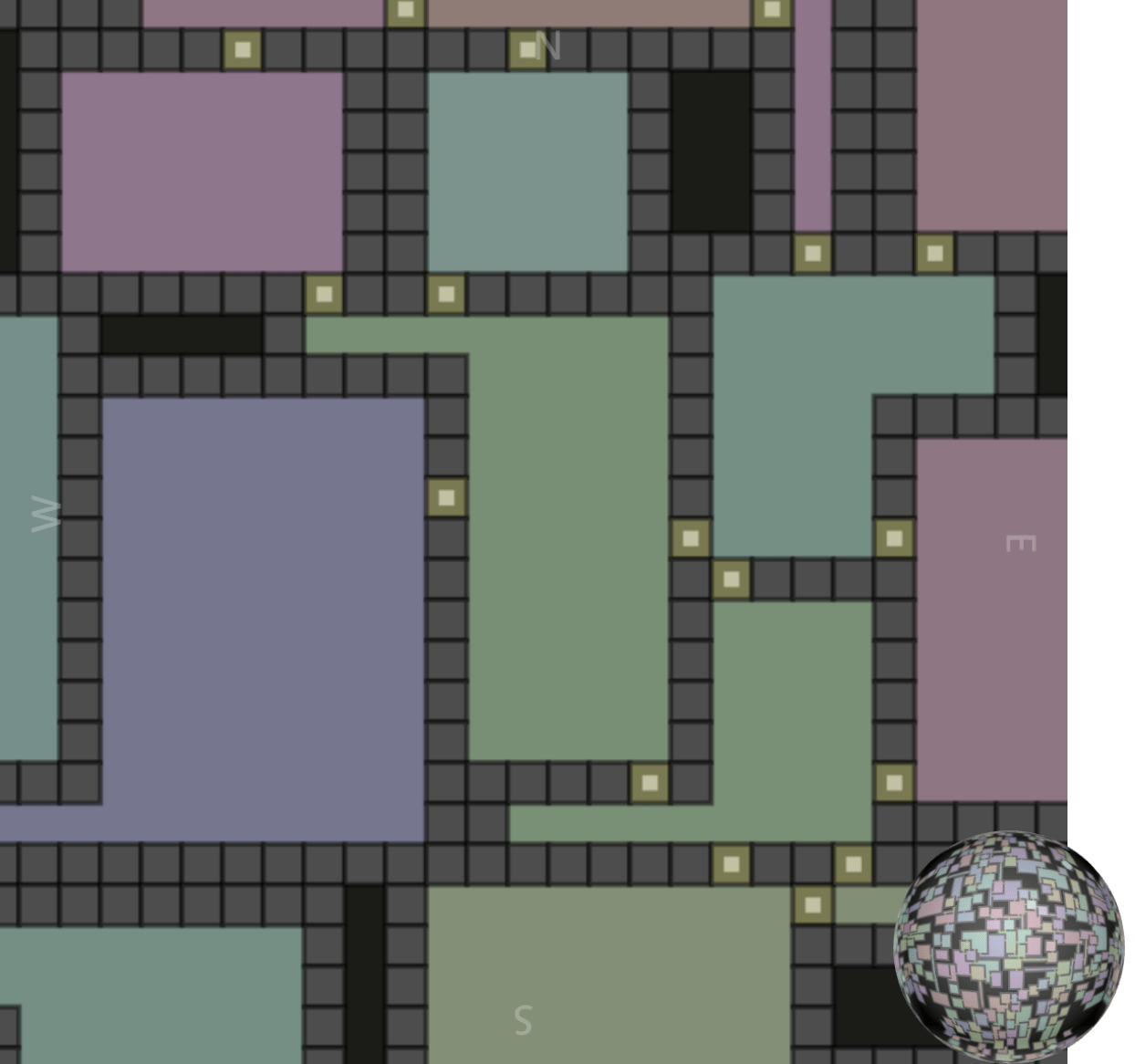
As the final step in learning how to work with square tiles on a sphere, I wanted to make something on the sphere. I decided to make a dungeon map.

Dungeon map on a sphere

Despite my interest in procedural generation, I've never made a dungeon map before. I wasn't sure how hard it would be to work with the cube/sphere geometry so I decided to keep the dungeon part of it simple. I started out making a dungeon on a single square face of the cube, and was hoping I could easily extend it to work on the entire cube. It worked out but not without some missteps. I think geometric dungeon-making techniques like binary space partitioning may be more difficult in the cube/sphere map than graph-based techniques like Delaunay triangulation or graph grammars, but it's hard to know until someone tries them.

I wrote my notes about making a planet-shaped dungeon.

Thoughts:

  • extending a square grid to a sphere is not too hard, as long as the player is mostly looking at the grid and not the sphere
  • the 8 corners of the cube are problematic, and it's easiest if you can have the player avoid them
  • some algorithms will extend to the cube/sphere much more easily than others
  • sometimes instead of modifying an algorithm to work on the cube/sphere, it's easier to have an algorithm pretend it's on a flat surface and then "fold" the coordinates onto the next side of the cube

I think that's it for this little exploration. It was fun and I learned a lot but I'm ready to move on to another project.

Friday, March 20, 2020

Busy Day!

What's going on everyone!?


Today makes 4 days before we have to be out of our old home and in our first ever house that we will own! This meant a LOT of moving today and even more tomorrow as our goal is to be out and sleeping in our new home by tomorrow night!

So with all of this in mind, please understand the reasons for me repeatedly playing all these app games. I will get to physical games as soon as I am able but currently our new house is so small that we can't even fit a kitchen table in there, lol.

Today for the #2019gameaday challenge I played another game of Zombie in my pocket and ALMOST walked away with a win but at the last second I ran out of time and all was lost.

It really is a fun game and I love that its just as easy to win as it is to lose!

As always, thank you for reading and don't forget to stop and smell the meeples!  :)

-Tim

Thursday, March 19, 2020

Got Beat Again

What's going on everyone!?


Today for the #2019gameaday challenge I played a solo game of Carcassonne and although I didnt place last I didn't place first. You know what our good friend Ricky Bobby says about that. ;)

It was a close game until the last 3rd of the game I would say. But that doesn't stop it from being any less fun!

I don't know if I'll ever be sick of this game or not but I can assure you that it will not be any time in the foreseeable future,  lol.

As always, thank you for reading and don't forget to stop and smell the meeples! :)

-Tim

Kickstarter Concluded


It's over.

Thank dread Cthulhu and His one-hundred-and-eleven slimy green tentacles!

Now, I can breathe a sigh of relief before diving back into the writing side of self-publishing.

What am I referring to?  Only the greatest Kickstarter comeback in the history of everything.  That's all.  Yes, Cha'alt: Fuchsia Malaise secured just over $13,000.  Less than I dreamed, but more than I realistically expected after the first 20-25 days where we seemed to be irrevocably stuck at about 7 grand. 

If you decide you want in, don't worry.  You didn't miss out on your chance to secure a luxury, signed, numbered, off-set printed hardcover edition of Cha'alt: Fuchsia Malaise (or it's predecessor... Cha'alt).

I can't keep this eldritch, gonzo, science-fantasy, post-apocalypse campaign all to myself, now can I?  Simply email me and we'll get you squared away: Venger.Satanis@yahoo.com

This past week, I ran three playtest sessions.  Two on Roll20, and one face-to-face.  I'll be blogging about them either tomorrow or the next day.

Besides saying THANK YOU to all my supporters, backers, fans, and fellow gamers, I'm done here.  ;)

VS

All You Need To Do Is Have Self-Compassion! And It's Rather Easy!

In training, the first thing we learned in therapy techniques was Carl Rogers' approach of unconditional positive regard for your clients. For me, he was the GOAT. Those who are suffering most likely haven't been given the love and nurturing they needed in childhood, adolescence, and even adulthood. 

Therefore, as therapists, you accept and support the person, without question. You accept the client, including their flaws, after all, everyone has weaknesses, no one is "perfect".

By giving unconditional positive regard, the client then begins to regard themselves more positively after being heard, accepted and supported, they begin to see that they're worthy. And, because they're worthy, they'll be more motivated to change - you take care of things that are valuable, which includes you!

For some reason, this message has been strangely forgotten after my training, because the concept of self-esteem was the fetish. To the point where we have clients write positive things about themselves to improve self-esteem. Esteem, meaning, that you value yourself for your positive qualities, and the more positive qualities, the better your self-esteem. 

Do you see the fatal flaw? When you start thinking of your negative traits, and we all have them as human beings, your self-esteem will fall. Also, what if one of the things you find positive about yourself is that you have beautiful skin, but as you age, it will "sag" and then your self-esteem will crumble. Or, that you're a kind person, but there are going to be times when you act unkindly (out of stress, we're all human), so that will also lower your self-esteem.

However, if you can accept yourself fully, warts and all, because you know that you're not perfect, and no one else is perfect, you begin to accept yourself, and in turn, accept others for not being perfect as well! Thus ending the deadly poison of self and other-criticism, that destroys creativity, inspiration, passion, productivity, and love.

Once you have self-compassion, you will be more motivated to act in more healthy ways such as exercising, not procrastinating, not being critical of others because you see that you're a valuable person. And if you're valuable, like all valuable things, you want to take care of yourself.

Here is the scientific breakdown for why self-compassion works, and why self-esteem doesn't:


How do you have self-compassion? The easiest exercise is to treat yourself as a best friend would treat you. You don't even have to be that mindful it's very obvious when you feel bad because they're such strong, obvious emotions:

Anger, stress, hatred, comparing yourself negatively to another person leading to jealousy and envy, criticizing yourself (which makes you feel down in the dumps), and so forth.

In this post, I will outline the steps with the best friend strat, and then give five very common scenarios when we tend to be really mean to ourselves, and show how you use this best friend approach.

BEST FRIEND APPROACH

Step One: As soon as you feel that sinking, negative gross feeling, stop and think about what you're upset about.

Step Two: Talk to yourself (internally or out loud) as if you're your own best friend, using this three step method:
  • Best friend will acknowledge the shittiness of how you feel and allow you to bitch and complain.
  • Next, best friend would say this shit happens to all of us, you're not alone, and of course you'd feel horrible, who wouldn't?
  • Lastly, how can we move forward and problem-solve?
EXAMPLES

Scenario One: You failed a test (or whatever project), you then begin to criticize yourself harshly and say that you're a complete loser and a fucking failure, you feel dejected and depressed. You feel like crap and crippled to do anything, which is the signal where you go into best friend mode:

As a best friend, he would tell you, that really sucks you got an F (or whatever failure), that's crushing and heart-breaking. He will say that we all fail, Edison failed millions of times, it never feels good but at least you tried and had the guts to show up and take that test (or do whatever project).

How can we do better to crush that test? And then come up with solutions in terms of studying "smarter" not "harder" (i.e. Gordon Greene's "Getting Straight A's"). You get excited and motivated so you order this used on Amazon.com and thank your best friend for support. Your friend says, "that's what friends are for!" You then get an A (at worst B+) on the next test.

Analysis: We see in this scenario how your friend acknowledged your feelings of suckiness when you got that big fat F.

He then universalized failure, that you're not the "only one" in the world who fails, so you're not the "sole loser outcast". Rather you're human just like everyone else.

Lastly, what can we do to change the outcome? Problem-solve and act upon the problem at hand!

Scenario Two: You're too tired to exercise yet again, even though exercising a mere 13 minutes, three times a week, can prevent major cardiovascular conditions that lead to death. 

You say to yourself that you're a lazy, pathetic, useless piece of shit who can't even do something as short as 13 minutes. You feel awful, which is the signal to go into best friend mode.

Best friend would say, no one likes to exercise, why do you think there are all these memes about hating exercise, and there's this viral cat video where the cat's so miserable to even move her left paw!

You're not lazy, you're human and like all the mammals in the world! ALL mammals are biologically wired to go the path of least resistance since calories are so scarce back then! Pampered pets tend to be overweight to obese, and inactive. The goal was to conserve the energy and hibernate in winter!

You feel better about yourself. Then he'll problem-solve and say, just go to the gym as the goal. If you don't want to exercise, then go back home. Most likely what happens is that you'll end up doing the 13 minutes, perhaps rounding up to 15 minutes or more.

Scenario 3: Your boyfriend dumped you, and you feel anger toward him. You also start feeling that you'll never find love again because you failed in this relationship. You tell yourself that you're unloveable, hideous, disgusting and trash. No one would love you ever again. You become depressed, which is signal to use the approach.

Your best friend might actually have a girl's weekend at your place to wallow in the sadness Friday night after work. She'll bring 12 different flavors of Ben and Jerry's, various chocolates, and order out pizza. You process the breakup and she tells you that everyone goes through breakups, it's a part of everyone's life - you're just like everyone in the world who's gotten rejected, I still love you. You feel better because of this truth. Then binge on Downton Abbey episodes.

But, on Sunday night, after you enjoyed the binge and wallow fest, your best friend tells you that you need to work on yourself and get healthy. She doesn't want to see you wallow in self-pity for months on end.

She tells you to go back to your life, go to work, take it one day at a time, socialize with your friends - you may meet eligible men. Feeling encouraged and supported, you begin to get over the break-up and taking healthy steps.

Scenario four: This is taken directly from my recent experience. You compare yourself negatively to another person. You begin to think why can't you be as fluent, as on point, as passionate, as humorous as Dr. Ramani:


Your friend notes that of course she's on point, she teaches this stuff every day to her students so she has to know the material like the back of her hand. For these interviews, she most likely prepared these answers in advance, and she has done so many, that it gets easier and easier!

I then feel better and interestingly, I felt gratitude (rather than feeling down on myself for "not measuring up") toward Dr. Ramani for helping people avoid getting involved with a narcissistic partner in the first place! Avoiding these people who destroy and crush others' souls (a malignant narcissist can conceivably kill his partner), literally saving lives.

Scenario five: You berate yourself for procrastinating yet again because you'd rather indulge yourself by playing video games. You call yourself pathetic, lazy and useless because you can't accomplish anything at all! 

How would you treat yourself with self-compassion? This is what I would tell myself, using the best friend approach:

I consciously tried self-compassion at work today which compelled me to write this post.

It was the first time where I felt light-hearted and a genuine joy, feeling full-hearted toward my coworkers without effort. I always feel the irritability when I'm at work, and use immense amount of energy to be pleasant to my coworkers since I like all my coworkers.

While they all say that I'm very easy to work with and non-intimidating, it takes up so much mental energy that I get drained at work. Which is why I end up playing video games after work. However today, having self-compassion, I have enough mental energy to write this post!

Despite being stressed today, interrupted every minute to sign, to make calls, and having to eat lunch in front of clients, I didn't feel mental fatigue, only physical fatigue. (The physical fatigue was my fault for not realizing I didn't have iron or synthroid in my weekly pill reminder box for the last 2 weeks, as well as untreated sleep apnea, and not exercising for being so tired).

At any rate, it was a wondrous feeling of being light and having this outpouring of love toward my coworkers (I do love them, I just don't feel it often due to work stressors), that I came up with rather creative solutions for a family, that surprised even myself!

The trap of doing any other exercises aside from self-compassion - activities such as keeping a gratitude journal, exercising regularly, and the like, is that if you don't do those things, you start feeling bad about yourself for being lazy, and you quit out of demoralization.

However, with self-compassion, you start feeling better. Even when you get down upon yourself for having a critical thought about yourself, you can snap out of it due to feeling the warning signs.

You may even laugh at yourself because of the irony. You're criticizing yourself for criticizing yourself! But by laughing at that, as your best friend would (perhaps even teasingly saying that you're a dork, but that makes you lovable), you can regain self-compassion.

Finally, as you accept yourself, flaws and all just like everyone else, you feel a sense of connection for others when you see them struggling, and end up having compassion towards them.

This feeling of love that you have to others make you feel even better and light - no jealousy, no bitterness, just a wonderful feeling of connection. We humans, as all the researchers say, are hard-wired for connection, and people tend to depression when you feel disconnected.

With self-compassion, as you feel better and find yourself worthy and worth doing all these hard things. You become more motivated to make healthy choices, do the gratitude exercises, eat healthy, get enough sleep, eat fruits and vegetables, just from self-compassion alone. 

The love you feel inwards and outwards becomes effortless, love being the powerful force, empowering you to do the hard, necessary things that are fulfilling to you.

The How of Happiness Review

Monday, March 16, 2020

Toy Soldiers, Part 1: Ronin

Seven samurai, painted and ready to fight!
British publisher Osprey has long been a staple in wargaming circles for their long line of excellent books on military history, covering armies, weapons, and battles throughout history with an eye towards the kind of detail that tabletop miniatures players would want for their games. More recently they've started putting out a series of rule books for miniatures wargaming. For the most part these are stand-alone books that don't come in a box with a bunch of figures, or require the purchase of specific packs of miniatures and accompanying stat cards and tokens. Rather, they are designed to evoke a particular historical period or fictional genre, and the players are free to use whatever miniatures they wish.

Having taken the plunge into miniatures gaming with games like 7TV, Doctor Who: Exterminate!, and Mythic Battles: Pantheon, I wanted to find a samurai themed game to indulge my love of Kurosawa movies, and Ronin: Skirmish Wargames in the age of the Samurai looked like just the thing, although it was another year after buying the rulebook before I got around to buying and painting enough samurai miniatures to play the game with.

After assembling some suitable terrain (mostly of the print-and-play, cut-and-assemble variety) we finally set up to play a game, a simple "defend the bridge" scenario with bloodthirsty bandits on one side and noble Koryu (sword fighting teachers and students) on the other.

The game aims for a "cinematic" style of combat, and does some interesting things that other games of this type don't really do. A game where the majority of the combat will be hand-to-hand could be quite dull -- once the figures have been moved into position, it could quickly devolve into die rolls back and forth, but Ronin opts for something different.

At the start of a hand-to-hand battle, each player secretly chooses a number of tokens based on the experience level of his characters. There are two different tokens to choose from: attack or defense. Once the die rolling starts, these tokens can be spent to improve a character's chance of attacking or defending successfully. What this amounts to is that players are forced to choose whether they want to focus on defense, attack, or try to balance out the two.

As with most games of this type, ranged attackers have the huge advantage of being able to attack from a distance (and in this game they get to attack first), but the game balances that by giving them fewer opportunities to increase their chance of hitting, and it also takes into account the slow reload times of ranged weapons from this time period.

Games are scenario based, usually with a specific goal for one side or the other rather than just "run to the middle and fight," and the game does a good job of allowing for narrative actions like looting bodies and picking up objects. It also has a whole system covering morale and the idea that if the fight is going badly, the troops might start running away.

We really enjoyed the game, and my only complaint isn't really a flaw in the game but an element that could be seen by many as a plus. The game doesn't come with pre-made character cards like its more commercial cousins tend to. Players are given example character types, with options for different weapons and abilities. Character stats are then copied onto a simple roster form for use during play. It works fine and is well suited to this style of game, but at the same time (and this is a very superficial criticism) it's an element of the game that is dry and uninteresting. Additionally, the hand writing and pre-game decision making makes it more difficult to just jump in and start playing, which means we won't get this game to the table very often.

Rating: 3 (out of 5) A great game system that works fine as-is, but could benefit from some more lavish support materials and a shorter prep time.